

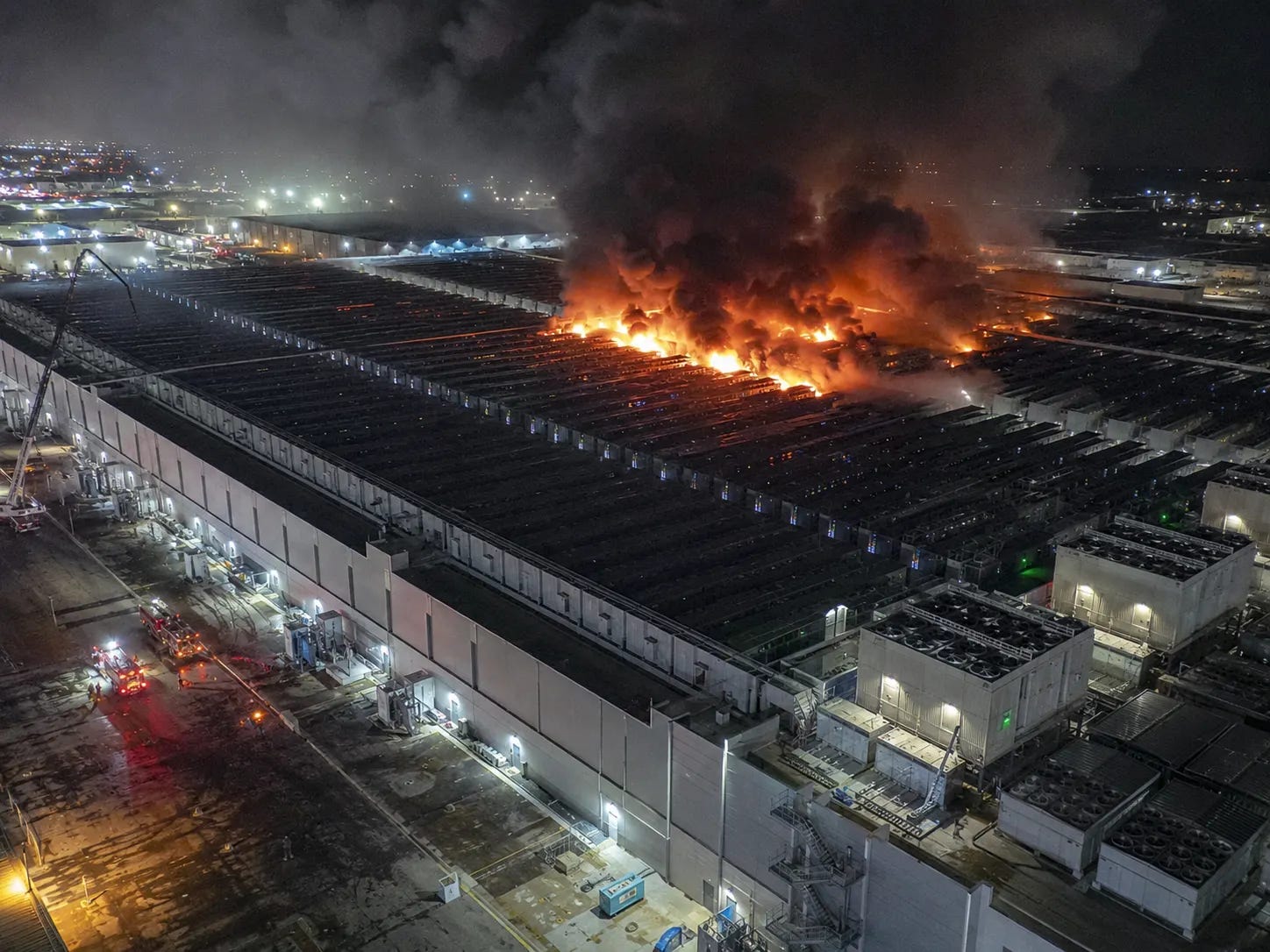
I have spent much of my career building and running High Performance Computing infrastructure. This means large InfiniBand fabrics connecting racks of computers that pull more power than a 3000 square foot home. Planning, designing, and procuring these systems are extremely complicated and expensive. I am familiar with CoreWeave’s operations, the hardware they deploy, and from what I can tell their business does not have much of a future for current equity owners. They are deploying the same commodity hardware as their competitors and have no comparative advantage. So the entire sector are effectively doing the same thing with the same gear. As I show in this analysis when the cost of capital becomes astronomical then there’s not much utility in engaging in such a business venture.
Reviewing their financials it’s clear that CoreWeave are a cash incineration machine. If we look at the second quarter of 2026 CoreWeave raised about $18 billion in debt, spent $6.4 billion on property and equipment, paid $640 million in interest, and in total lost $626 million. Revenue was $2.58 billion. From these terrible numbers it’s pretty clear that while the company is growing revenue at 112% YoY its interest bill is growing faster at 140%. Equity investors should be very concerned as this is negative carry which means the marginal utility of adding new GPUs actually creates more losses for the company.
Revenue growth cannot outrun this capital structure when the business generates zero organic (not leverage-driven) Free Cash Flow (FCF). CoreWeave’s June 30 10-Q shows $35.6 billion in debt, $16.3 billion in lease liabilities, and another $35.5 billion in leases it signed but not yet started paying. This is all sitting on top of $5.0 billion of shareholders’ equity. Looking ahead the situation does not look much better. For example CoreWeave’s third-quarter interest expense is guided to be anywhere from $860 to $940 million. So in summary that’s a $3.6 billion annual run rate against roughly $1 billion of adjusted operating income for the entire year. Cash incineration machine.
If we look at contracted obligations the problem only looks like an ever-growing disaster. For example to build the 4.2 GW of power it has already sold, the company needs around $79 billion of additional debt through 2029. None of this debt can be self-funded unless they massively dilute existing equity shareholders and get some bailout which seems unlikely due to moral hazard. From this reality I performed a DCF analysis, discounted at the 15% yield on CoreWeave’s own unsecured notes, which shows this company will be heading to bankruptcy. Existing shareholders only have any value in their equity if GPUs last eight years and the company can borrow at 9 to 11%. These are both extremely unrealistic scenarios yet I show they are the only ones which permit existing shareholders to have any value.
I. Latest 10-Q Summary
For my analysis I used numbers from the 10-Q for the quarter ending June 30, 2026 as well as the August 11 earnings call. I encourage anyone long to read Note 10 (debt) and the commitments note themselves because they show the two biggest concerns. Looking into the carnage we see that debt principal for this quarter was $35.55B. Sell-side debt tables place total drawn debt at roughly $41 billion by mid-October. They have tapped 18 separate credit facilities. CoreWeave’s existing unsecured notes carry 9.00 to 9.75% coupons and trade at yields near 15%. The credit default swap market shows a five-year default probability around 50%. These facts should not make equity shareholders feel very good especially considering token prices are on a downward trajectory. They explain why CoreWeave’s stock price has been in decline nearly 60% for the past year.
The problem does not get any better since on top of the debt sit $16.3 billion of operating lease liabilities. Even further on top again sits $35.5 billion of leases the company has signed but which have not yet commenced. Importantly for investors that last number does not appear on CoreWeave’s balance sheet. Rather you will find it in the commitments note. It is a locked-in obligation for data center space CoreWeave has promised to fill between now and 2029. So basically the negative-carry problem for CoreWeave only gets worse over time.
Let the carnage continue. Reviewing this mess further we see that CoreWeave’s total liabilities are $72.0 billion, total assets at $77.1 billion, while shareholders’ equity is $5.0 billion. Anything to feel good about? Well cash was $5.5 billion, plus $1.4 billion of restricted cash that is pledged to lenders and so does not count. So it’s accurate to state that the company is 93% liabilities before you count the leases that have not started. As a result I do not think there’s any reason to feel positive about CoreWeave.
Customer concentration is a huge issue as it creates massive counterparty risk. As reported recently by multiple news outlets CoreWeave, like all neoclouds, suffers from this problem. Apparently two customers accounted for 63% of first-half revenue (40% and 23%) and 32% each of receivables. If the company was happy with this relationship then we would see transparency on this matter. Yet quarterly filings do not name them though the $22.4 billion of OpenAI contracts and the long Microsoft relationship are public record. I will let readers draw their own conclusions regarding the identity of customers A and B.
Is there any reason to feel good about CoreWeave? Not really. We see that interest expense on debt was $267 million in the second quarter of 2025. The problem has only gotten worse. Interest paid was $640 million in the second quarter of 2026. The problem will only get even worse as management guided third quarter interest payments in the range of $860 to $940 million.
If we synthesize all of this information then full-year 2026 adjusted operating income sits at $960 million to $1.15 billion with full-year 2026 capital expenditure ranging from $35 to $39 billion.
So in 2026 the company expects to earn about $1 billion from operations before interest this year. It expects to pay more than that in interest in the second half alone. In addition it expects to spend 35 times its operating income on new equipment. This is a cash incineration machine.
Proponents of CoreWeave will say that their adjusted EBITDA margins of 59% means this is a great business. Yet depreciation is $1.4 billion a quarter and rising with every GPU that arrives. That, along with the terrible cost of debt and deflating token prices, means their negative carry problem only gets worse the more they spend on expanding the business. The 5% adjusted operating margin is the number after the hardware wears out on paper. The real operating margin, GAAP, was negative by two percent. I do not see anything positive with this enterprise.
II. The Six Year GPU
Most bear pieces on CoreWeave argue that GPU rental prices are collapsing. That argument has a problem because CoreWeave raised prices roughly 25% across its SKUs in July. Demand for the current generation of hardware exceeds supply and the company is pricing accordingly. So I am not going to pretend otherwise.
As my models show the pricing risk is not in year one of a contract rather it is year six and beyond.
CoreWeave depreciates its GPUs over six years. Its customer contracts run about five that means they are constantly having to replace this gear. The hardware is financed with debt that amortizes over roughly the same period as the contract which is a sensible structure on its face. Though it means the equity return on every cluster comes almost entirely from what the hardware earns after the first contract ends, when it is five years old, two generations behind, and competing for renewal against new silicon that delivers several times the performance per watt.
That is where the token price collapse matters. Frontier API prices have fallen more than 90% in three years because each hardware generation, and each model architecture, does more work with less gear. A five-year-old GPU in 2031 will be renting into a market where the marginal cost of a token is a small fraction of what it is today.
J.P. Morgan’s bull case claims that because V100s are still in commercial use after eight years, an extended useful life is justified. That confuses physical survival with economic utility. A V100 still draws power, but it rents on secondary clouds for $0.50 to $0.80 an hour which means an 85% to 90% collapse from what could be charged on a new V100 back in the day. Meanwhile, the power, cooling, and data center space to house that chassis has not dropped a dime.
The cost to maintain the V-100s greatly increases as does the job failure rate (aka upset customers) for users on those older GPUs. So when your hourly rental rate falls below the power, cooling, and facility OpEx floor required to keep the server running, keeping the GPU plugged into the wall produces negative gross margins.
A chip can physically run for a decade, but once it costs more in electricity and maintenance to operate than it generates in revenue, its terminal value is zero.
Older GPUs are not an asset but a space heater.
The useful-life question is not academic.
Instead it decides whether the terminal value of this business is positive or negative.
III. The CoreWeave Funding Gap
I built a four-period model from their latest quarterly filing. The inputs are the company’s own second-half 2026 revenue. Capex are the full-year guidance midpoints less the first-half actuals. 2027 revenue is the Bernstein estimate. 2028 through 2029 revenue ramps toward the 4.2 GW of contracted power at roughly $10 billion of revenue per gigawatt which is what the year-end run-rate guidance implies. Capex from 2027 to 2029 is about $84 billion. That’s what the remaining 2.35 GW costs at the $36 billion per gigawatt which the company has actually been spending. Interest is 8.75% on beginning-of-period debt which is slightly below what the Q3 guide implies.
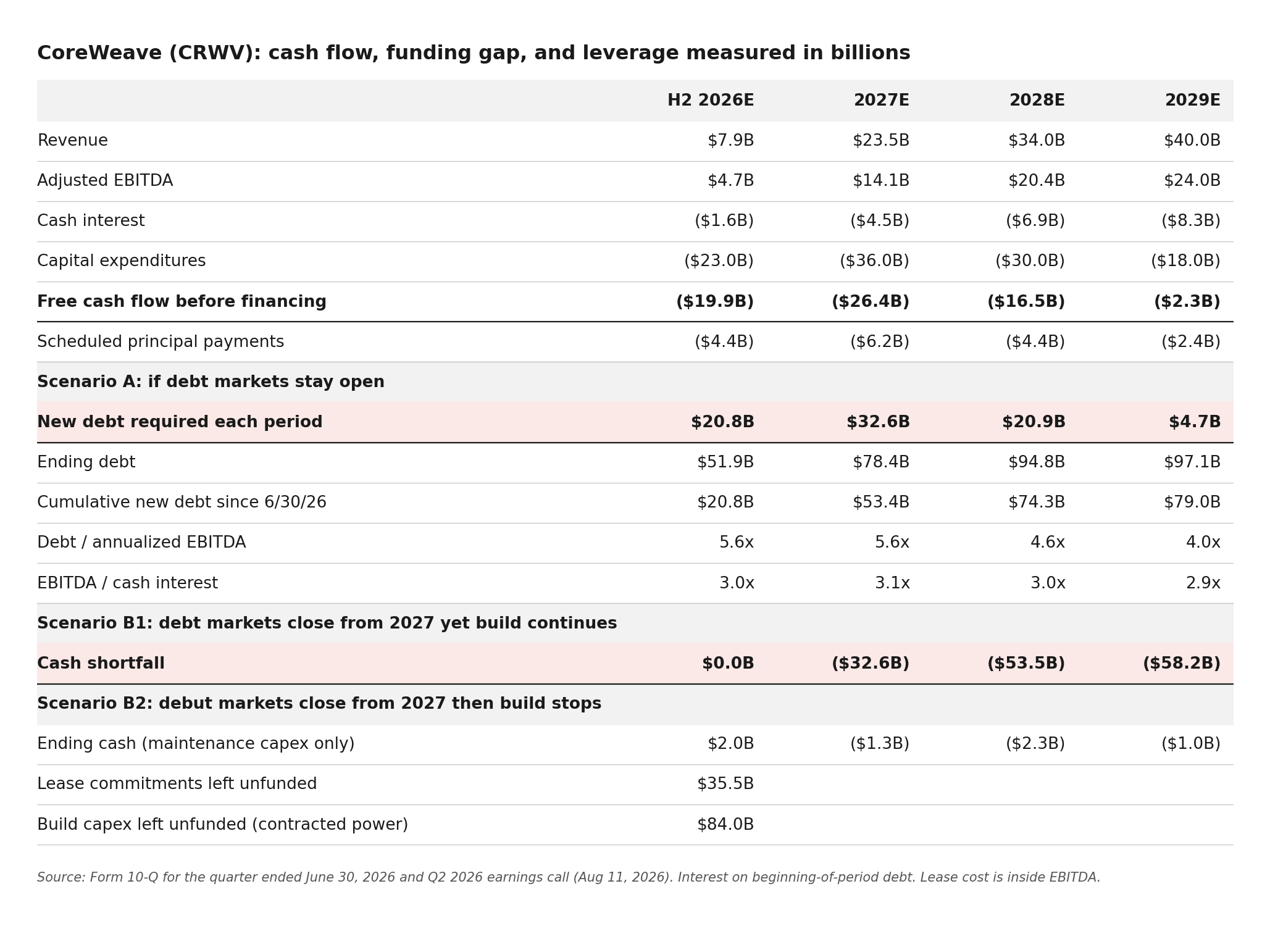
Scenarios for CoreWeave (Author)
FCF before financing is negative $19.9 billion in the second half of this year, negative $26.4 billion in 2027, negative $16.5 billion in 2028. It does not turn barely positive until 2029. Scheduled principal payments on top of that are $4.4 billion, $6.2 billion, $4.4 billion and $2.4 billion respectively.
If the debt markets stay open, meaning they keep lending to the company, then CoreWeave needs to raise roughly $21 billion in the second half of 2026, $33 billion in 2027, $21 billion in 2028 and $5 billion in 2029. That is $79 billion of new debt on top of what is already outstanding. Debt peaks near $97 billion. Interest reaches $8 billion a year. Debt to EBITDA stays above 4x the whole way and interest coverage never gets above 3x.
Those are the good-case numbers. That is the company continuing to operate as usual.
If the debt markets close after 2026 and the company keeps building what it has contracted then it runs out of cash in the first month of 2027. If it stops building then it can just barely service its existing debt on the roughly $19 billion run rate it will have by the end of 2026. This means cutting all CapEx to maintenance of existing gear. This means dealing with failed network interface cards, bad cables, and swapping servers but not actually expanding the business. If other neoclouds are expanding while CoreWeave goes into maintenance then they lose market share thus even more income. However it then defaults on $35.5 billion of signed leases and on the contracted power it cannot deliver. Then the $104 billion backlog that supports the entire equity story is not a backlog anymore but a stranded asset liability.
That is the structure what I am putting forward in this analysis. It’s clear to me that the company cannot stop building without breaching its commitments and it cannot keep building without the bond market saying yes every six months through 2029.
IV. DCF Analysis of CoreWeave Equity
I performed a DCF analysis using the same 15% yield on the company’s unsecured notes as my WACC (discount rate). You can download the model to examine it for yourself.
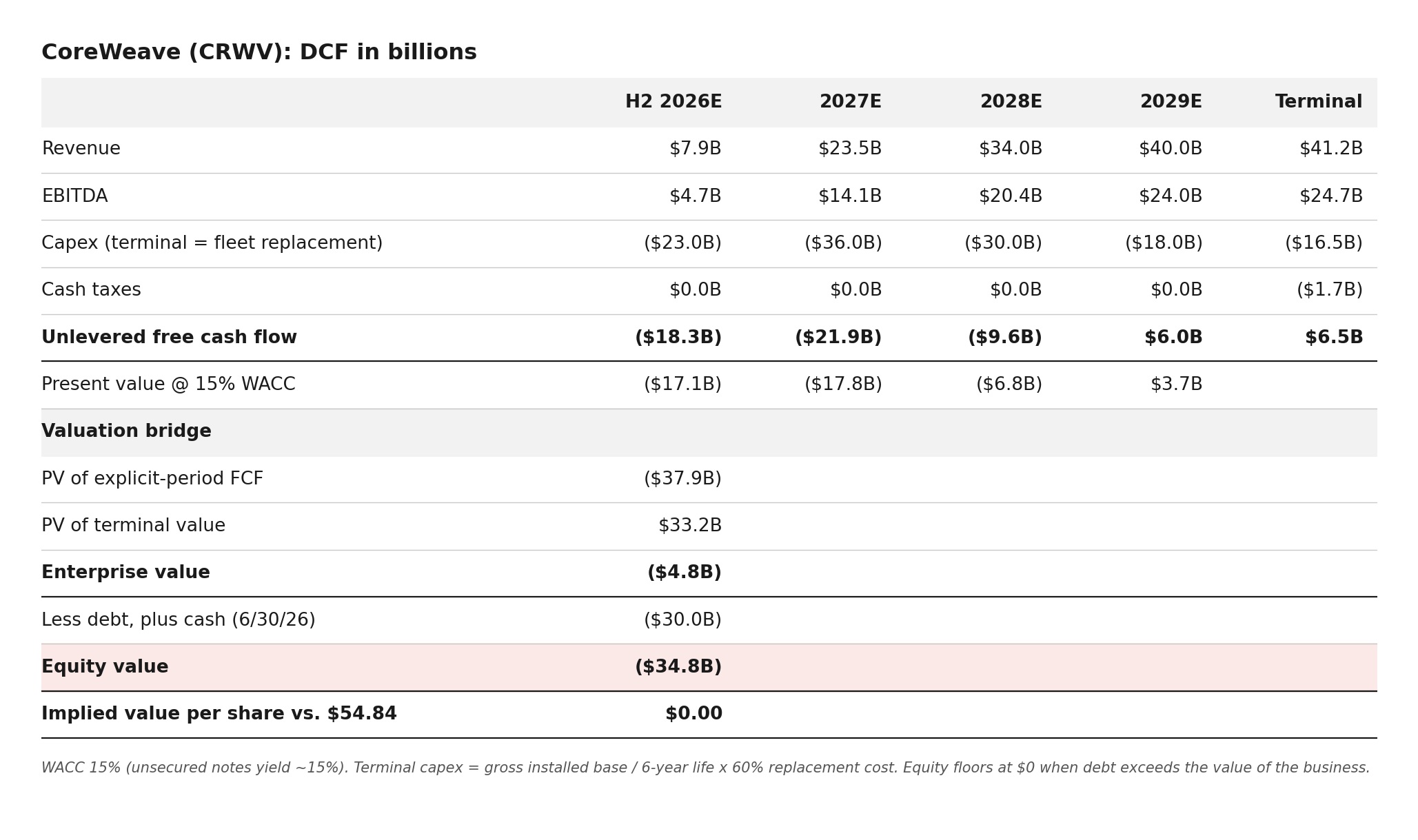
Discount Cash Flow Analysis (Author)
From my model I believe the present value of the next three and a half years of FCF is negative $38 billion. CoreWeave’s terminal value, assuming 60% EBITDA margins forever (which is extremely generous as it defies financial gravity) and a fleet that gets replaced every six years at 60% of original cost, is $33 billion today. Enterprise value is negative $5 billion. Subtract $30 billion of net debt and the equity is worth negative $35 billion which rounds to zero dollars per share.
I want to be precise about what that means. It does not mean CoreWeave is worth nothing. The GPUs, the power contracts and the data center leases are real and somebody will always own those assets. Though it means that at a 15% cost of capital, the cash the business generates does not cover the debt that bought the assets, and the equity sits behind that debt. Thus if conditions do not change for CoreWeave then existing equity shareholders will be wiped out in bankruptcy.
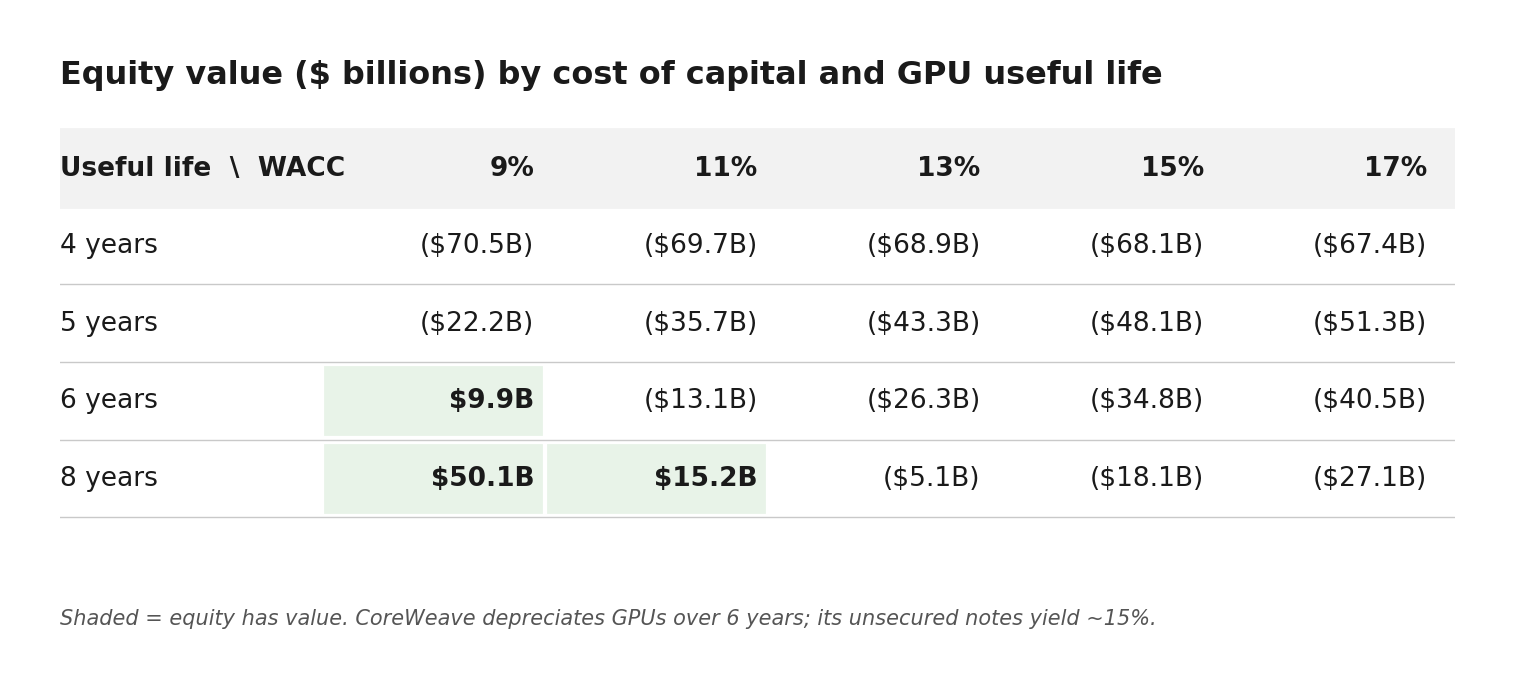
What’s CoreWeave Really Worth (Author)
Looking at the value of CoreWeave’s assets over time, the equity is worth something in exactly three of twenty cells: GPUs lasting eight years at a 9% or 11% cost of capital, or six years at 9%. Everywhere else the debt is bigger than the business. CoreWeave’s own bonds say its cost of capital is 15%. Its own depreciation policy says its GPUs last six years. Thereby on the company’s own two inputs which they disclose the value of their equity is a big fat zero.
V. Equity Shareholders Should Be Cautious
The whole AI bubble is economically unsustainable because it’s a prisoner’s dilemma where companies are forced to keep incinerating massive amounts of CapEx just to constantly retrain models. At the same time, you are bleeding cash running inference while token prices keep dropping and many models are being handed out for free. In addition your GPUs also aggressively depreciate so you have to keep replacing them along with the racks cooling and networking which does not transfer between generations. This is the big pain going from Hopper to Blackwell to Rubin as it’s a never-ending CapEx and OpEx (hiring people who know how to do this stuff is very expensive). Incinerating billions in infrastructure capital for a deflationary asset class with zero un-levered FCF is simply an economic disaster.
I have managed and deployed High Performance Computing clusters including those with GPUs for over a decade. I have negotiated with vendors, profiled research workloads, racked actual gear, and designed a reference architecture for AI training and inference workloads. I also have a degree in political science and urban planning. I read extensively. From my understanding of history every infrastructure boom I know of ended the same way. These include railroads in the 1870s, telecom fiber in 2001, and shale in 2015. The assets were built, they were used, and they are still around today. However the investors who financed the build-out at the top of the business cycle did not own those assets when they started to generate value.
I do not doubt that CoreWeave’s GPUs will be running for many years to come. However from my Discount Cash Flow (DCF) model I can guarantee that they will be doing it inside a hyperscaler, or within a restructured entity that bought them from one of 18 lenders for a fraction of what they cost. These scenarios will wipe out current equity shareholders.
I am not saying this will happen next quarter but the trajectory for CoreWeave seems undeniable.
I would not recommend CoreWeave to any AI lab, hedge fund, or major research institution looking to acquire GPU resources at scale. The counterparty risks are too high.
Disclosure: I do not have any short or long position in CoreWeave, any of their competitors, or their customers. Given I believe CoreWeave equity would be worthless, if I were in a position to take a short position in this company then I would do so.
Sources:
CoreWeave Reports Strong Second Quarter 2026 Results — Nasdaq
CoreWeave Q2 2026 earnings call transcript (Aug 11, 2026)
CoreWeave Q2 2026 10-Q summary — StockTitan
CoreWeave debt: repayment dates, collateral and customer concentration — altss
CoreWeave Debt Concerns Resurface: J.P. Morgan vs Bernstein — 404k Research
CoreWeave Q2 2026: $129B backlog, CDS-implied default odds — TechTimes
The credit side of this reached earnings calls in October. On Blackstone's October 22 call, a Goldman Sachs analyst asked about "wider credit spreads and CDS levels move up for neoclouds and to some extent, some of the more established players", and the same day Lazard's chief executive said the risk of financial distress among the independent frontier labs or some neocloud providers "is elevated". CoreWeave itself uses the word only about other providers: four times on six calls.
I work at Equibles, and we tracked who says "neocloud" across 36,283 earnings calls here: https://equibles.com/research/who-talks-about-neoclouds-on-earnings-calls-evidence-from-36-283-calls